

LA Mousse (NVE) Hash
Price range: $100.00 through $2,200.00
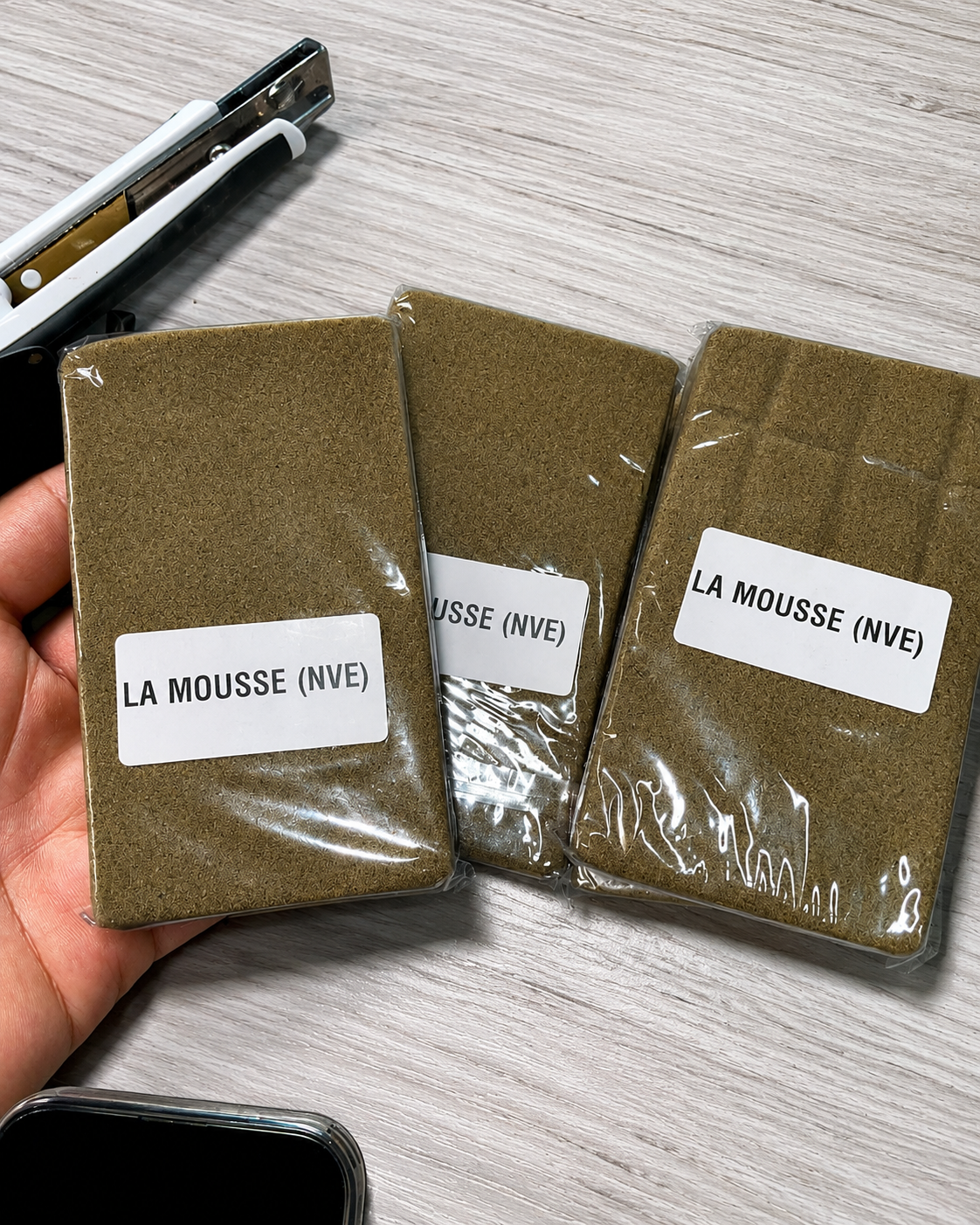
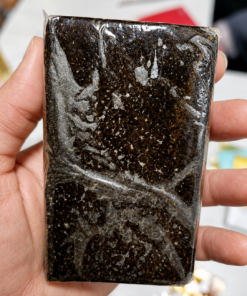
LA Mousse (NVE) is presented as individually wrapped cannabis resin with a compact rectangular form and a brown-to-green-brown exterior. This guide explains LA Mousse terminology, texture, appearance, quality indicators, verification, and the limits of judging hash by its name or color alone.
LA Mousse (NVE) Hash: Appearance, Terminology, Quality and Verification Guide
LA Mousse has become a recognizable term in discussions surrounding European cannabis resin, yet the name is frequently treated as though it describes a precise hash grade. In practice, the terminology is much less exact.
A product identified as LA Mousse (NVE) can tell you how the material is being presented, but the name alone does not establish its chemistry, strength, cultivar, production technique, geographical origin, or overall quality.
That distinction is useful for anyone researching LA Mousse hash, particularly when comparing different resin styles online. Hash can vary considerably even when two products share similar names and appearances.
Instead of treating “mousse” as a guarantee, the better approach is to understand what the term generally describes, what physical characteristics may be relevant, and which questions can only be answered through traceable product information or laboratory analysis.
Understanding the LA Mousse Hash Name
LA Mousse, sometimes shortened simply to mousse hash, is terminology encountered in European cannabis-resin discussions. The word is commonly associated with hash that is comparatively soft, friable, airy, or easy to break apart.
It should not, however, be interpreted as a universally recognized scientific classification.
Cannabis resin itself has a much clearer definition. Hash or hashish consists of separated resinous material derived from cannabis and formed into a concentrated product. Traditional resin production has included methods such as sieving and hand rubbing, although cannabis-resin processing varies considerably.
“Mousse” sits within this broader world of cannabis resin as informal descriptive terminology rather than a laboratory-defined category.
This explains why LA Mousse products found in different markets do not necessarily share identical characteristics. The same name can be attached to materials that differ in color, firmness, resin content, aroma, composition, age, and processing history.
Understanding that distinction prevents the product name from doing more work than the available information supports.
LA Mousse (NVE) at a Glance
The LA Mousse (NVE) presentation has several straightforward characteristics.
The material appears in individually enclosed rectangular blocks carrying the LA MOUSSE (NVE) name. The exterior has a fine, compact-looking surface with coloration extending through muted brown, olive-brown, and green-brown tones.
These characteristics are useful for describing the physical presentation of this particular LA Mousse product.
They should not be confused with chemical specifications.
The appearance of cannabis resin cannot independently establish cannabinoid concentration, terpene composition, cultivar, contaminants, geographical origin, or manufacturing history.
This principle applies to virtually every hash product. Visual examination is useful for understanding form and surface characteristics, but considerably less useful when the question moves from “What does it look like?” to “What exactly is inside it?”
What Does NVE Mean in LA Mousse (NVE)?
NVE appears alongside the LA Mousse name as an additional identifier.
Without a defined manufacturer specification or other reliable product documentation explaining the abbreviation, NVE is best retained as part of the product name rather than expanded into an assumed meaning.
Three-letter abbreviations can represent brands, producers, product lines, locations, internal classifications, or completely unrelated terms.
Assigning an unverified definition can therefore create inaccurate product information that is subsequently repeated elsewhere.
For practical identification, the terminology can simply be understood as:
Name: LA Mousse
Identifier: NVE
Category: Cannabis resin/hash
Any more specific interpretation should depend on documentation associated with the relevant product.
Appearance and Surface Characteristics
One reason LA Mousse attracts attention is its recognizable block-style presentation.
The material has a compact rectangular shape rather than the loose granular structure associated with some modern solventless concentrates. Its exterior shows fine surface detail rather than a completely polished or glossy finish.
Color falls broadly within an earthy spectrum.
Brown, olive, muted green, tan, beige, and golden-brown shades can all occur across cannabis resin generally. Differences in lighting can also make the same piece appear substantially different between photographs.
That makes color useful descriptively but weak diagnostically.
A greenish hash is not automatically low quality. A pale hash is not automatically premium. Dark resin is not automatically old or contaminated.
To understand why, it helps to look at what actually determines hash appearance.
What Determines the Color of Hash?
Cannabis resin can develop different colors because numerous variables influence the finished material.
Starting material matters, but it is only one part of the picture. Trichome maturity, separation efficiency, plant material, compression, temperature, oxidation, storage conditions, age, and processing can all affect the final appearance.
The exterior can also differ from the interior.
Compressed resin may oxidize or darken at the surface while retaining a noticeably different color after being opened. Other products remain relatively uniform throughout.
This makes claims such as “lighter hash is always better” unreliable.
Color should instead be considered alongside texture, aroma, cleanliness, storage history, provenance, and analytical information where available.
LA Mousse Texture Explained
Texture is one of the characteristics most strongly associated with the word mousse.
In informal market language, mousse commonly suggests resin that is softer or more friable than extremely dense, hard-pressed hash. Some examples may break apart easily, while others can become more pliable with changes in temperature.
There is still considerable room for variation.
A name cannot tell you exactly how an individual block will behave when handled. Firmness may be affected by resin composition, temperature, age, compression, and storage.
This is why descriptions of LA Mousse texture should avoid treating softness as an absolute requirement.
A useful description focuses on observable physical characteristics while recognizing that the term represents a general style rather than an engineering specification.
LA Mousse vs Other Hash Styles
Searching for LA Mousse vs hash can be confusing because LA Mousse is already part of the broader cannabis-resin category.
The difference is mainly one of terminology and expected physical style.
| Characteristic | LA Mousse terminology | Cannabis resin generally |
|---|---|---|
| Product family | Hash/cannabis resin | Hash/cannabis resin |
| Formal universal grade | No | Broad recognized category |
| Typical terminology | Often associated with softer resin | Covers many resin styles |
| Texture | Can be soft or friable | Soft, firm, crumbly or dense |
| Color | Variable | Highly variable |
| Cannabinoid content | Not defined by the name | Product and batch dependent |
| Geographic origin | Not established by “mousse” | Multiple producing regions |
| Quality | Requires further evidence | Requires further evidence |
The important point is that mousse should not be positioned as the opposite of traditional hash.
It is better understood as terminology used for a particular perceived style within a much larger category.
Is LA Mousse a Hash Quality Grade?
No universal grading system defines LA Mousse as a specific quality level.
This matters because cannabis terminology frequently develops through informal markets before consumers begin treating the terminology as though it were standardized.
Terms can eventually acquire strong associations without acquiring a formal specification.
A genuine grading standard would need measurable criteria. Those might include trichome purity, cannabinoid composition, contaminant limits, moisture, processing parameters, or another defined characteristic.
The word mousse provides none of those measurements by itself.
Therefore, seeing LA Mousse on a label should identify a product style or market name, not automatically communicate premium, mid-grade, low-grade, or another formal quality category.
Can You Judge LA Mousse Quality by Appearance?
Appearance provides information, but only within limits.
Visual inspection can reveal basic physical characteristics such as shape, surface consistency, visible foreign material, major discoloration, or obvious packaging damage.
It cannot reveal everything consumers commonly associate with “quality.”
For example, visual inspection does not measure THC or CBD. It cannot produce a terpene analysis. It cannot reliably identify invisible contaminants, and it cannot prove where cannabis resin was produced.
This is why attractive hash and analytically verified hash are not necessarily the same thing.
The strongest assessment combines physical observations with reliable provenance and testing rather than relying on photographs or marketing terminology alone.
Why LA Mousse THC Percentage Varies
There is no single LA Mousse THC percentage that can reasonably be applied to every product carrying the name.
Cannabinoid concentration varies naturally across cannabis material and can change further depending on resin separation and processing.
Even two batches produced in broadly similar ways can differ.
The European Union Drugs Agency defines cannabis resin as separated resin obtained from cannabis and notes that resin products can vary substantially in appearance, texture, odor, and potency.
That variation is important when interpreting online descriptions.
A percentage associated with another mousse product, another producer, or a general market average should not be transferred to LA Mousse (NVE).
Only analytical testing associated with the relevant sample or batch can provide a meaningful cannabinoid measurement.
Why Batch Information Matters
Product names are useful for identification, but batch information is considerably more useful for chemistry.
Imagine two resin blocks sold under the same LA Mousse name.
They may look similar while having different cannabinoid profiles, terpene compositions, ages, storage histories, starting materials, or processing characteristics.
This possibility increases when a term functions as a market category rather than a tightly controlled product specification.
For that reason, general LA Mousse reviews should be interpreted carefully.
A review can describe the specific material examined by the reviewer. It cannot establish that every product carrying the same name will reproduce those characteristics.
Batch-level evidence remains more informative than reputation alone.
Is LA Mousse Moroccan Hash?
LA Mousse is frequently discussed alongside European and North African hash terminology, which can lead to assumptions about Moroccan origin.
Those assumptions should be separated from provenance.
Morocco has historically been an important source of cannabis resin entering European markets, and the EUDA identifies North Africa as a major source region for resin.
That historical and market context does not mean every product called LA Mousse was produced in Morocco.
Cannabis resin is also produced in other regions, including within Europe itself.
Origin therefore needs its own evidence.
A name, color, shape, texture, or style may resemble products associated with a particular region without proving that the individual material originated there.
Mousse Hash vs Dry Sift
Another useful distinction concerns production terminology.
Dry sift describes a method based on mechanically separating trichomes from cannabis material using screens or sieves. The collected resin material may subsequently be pressed into hash.
Mousse, by comparison, generally describes a market style rather than one universally defined separation technique.
That means these terms are not necessarily mutually exclusive.
A resin product could potentially have characteristics people describe as mousse while having been produced using sieved material. Without production documentation, however, its exact method should not be inferred simply from its texture.
This distinction helps keep processing terminology separate from appearance-based terminology.
LA Mousse vs Bubble Hash
Bubble hash is associated with a more specific production concept.
It uses water, ice, agitation, and filtration to separate resin-rich trichomes from cannabis material. Different filtration sizes can then produce different grades of collected material.
LA Mousse does not inherently describe that process.
Therefore, calling something LA Mousse does not mean it is bubble hash, ice-water hash, dry sift, static sift, or another particular resin type.
Those descriptions should only be used when the production method is known.
For consumers comparing different hash categories, this is one of the most useful distinctions to understand: texture terminology and processing terminology are not interchangeable.
Does Soft Hash Mean Strong Hash?
Softness and potency describe two different properties.
Texture is physical. Potency is chemical.
A soft piece of resin may contain more or less THC than a harder sample. The same is true for crumbly, oily, sticky, dry, light-colored, or dark-colored hash.
Temperature further complicates comparisons because resin can change considerably as it warms or cools.
Using softness as a shortcut for potency therefore creates an unreliable quality test.
The same principle applies to aroma. A strong smell can indicate abundant volatile aromatic compounds, but aroma intensity is not a THC measurement.
Cannabinoid analysis remains the appropriate way to answer potency questions.
What Laboratory Testing Can Reveal
Laboratory testing fills many of the information gaps left by physical examination.
Depending on the analytical panel, laboratory analysis can measure cannabinoids and investigate selected contaminants. More specialized testing may provide additional information about chemical composition.
This creates an important distinction between identity, potency, and safety.
Knowing that a material belongs to the cannabis-resin category does not automatically tell you its cannabinoid concentration.
Knowing cannabinoid concentration does not automatically establish that it passed contaminant screening.
Likewise, attractive appearance does not establish either.
For products where analytical documentation is available, batch-specific results provide substantially more useful information than general claims attached to the LA Mousse name.
Understanding Authenticity and Provenance
“Is LA Mousse real?” is a difficult question because LA Mousse does not function like a universally standardized branded specification.
Authenticity becomes much easier to evaluate when a product has a known producer, traceable batch system, regulated labeling, verifiable laboratory documentation, or another reliable chain of custody.
Generic packaging offers fewer reference points.
A label can identify what a product is being called, but the label alone cannot independently authenticate the material inside.
For LA Mousse (NVE), provenance should therefore be treated separately from appearance.
The product name is one piece of information. Establishing who produced it, where it originated, how it was processed, and what it contains requires additional documentation.
What Matters When Evaluating Cannabis Resin?
A useful hash assessment considers several characteristics together rather than searching for one visual shortcut.
Appearance helps describe the physical material.
Texture explains how the resin behaves physically.
Aroma can reveal aspects of its volatile profile but does not measure potency.
Provenance helps establish where the material came from.
Batch information connects documentation to a specific production run.
Laboratory analysis can provide chemical measurements that appearance cannot.
No single characteristic replaces the others.
This broader framework is more useful than treating words such as mousse, premium, blonde, soft, traditional, or imported as complete quality grades.
Storage and Condition
Storage can change cannabis resin over time.
Heat, oxygen, light, and repeated temperature changes may affect physical consistency and chemical stability. A block that originally had one texture may behave differently after extended storage.
Keeping resin sealed and protected from excessive heat, moisture, and direct light helps reduce unnecessary environmental exposure.
Condition should also be distinguished from original quality.
Poor storage can degrade otherwise well-produced material, while attractive storage presentation cannot improve weak starting material.
When comparing hash products, storage history can therefore be relevant even when two samples originally came from the same batch.
Common LA Mousse Myths
Several assumptions repeatedly appear around mousse hash.
“Blonde mousse is always better.”
Color alone cannot establish overall quality.
“Soft hash means high THC.”
Texture does not measure cannabinoid concentration.
“LA Mousse always comes from Morocco.”
The terminology does not establish geographical origin.
“Mousse is a formal hash grade.”
There is no universal analytical mousse classification.
“You can identify clean hash visually.”
Some obvious physical problems may be visible, but chemical composition and many contaminants require analytical methods.
Recognizing these limitations makes comparisons between resin products considerably more meaningful.
Frequently Asked Questions About LA Mousse (NVE)
What is LA Mousse hash?
LA Mousse is terminology used for cannabis resin and is often associated informally with relatively soft, friable hash. It remains part of the broader cannabis-resin category rather than a separate scientifically standardized class.
What is LA Mousse (NVE)?
LA Mousse (NVE) identifies the resin product discussed here, with NVE appearing as an additional product identifier.
What does NVE mean?
A specific expansion of NVE should depend on reliable documentation defining the abbreviation.
Is LA Mousse strong?
The name does not determine potency. Cannabinoid concentrations can vary between products and batches.
What percentage THC is LA Mousse?
There is no universal THC percentage for LA Mousse hash. A meaningful percentage requires analysis of the relevant product or batch.
Is LA Mousse Moroccan?
The LA Mousse name does not prove geographical origin. Morocco is historically important to the European cannabis-resin market, but individual provenance requires separate evidence.
Why is LA Mousse soft?
Mousse terminology is commonly associated with softer or friable resin, although actual consistency can vary according to composition, processing, temperature, age, compression, and storage.
Is lighter LA Mousse better than dark hash?
Not automatically. Color alone cannot determine cannabinoid concentration, cleanliness, freshness, origin, or overall quality.
Is LA Mousse the same as dry sift?
Not necessarily. Dry sift describes a trichome-separation technique, whereas mousse is generally used as descriptive market terminology.
How can LA Mousse quality be checked?
Physical examination can describe appearance and condition. Reliable provenance, batch documentation, and appropriate analytical testing provide substantially stronger evidence about composition and quality.
Final Perspective on LA Mousse (NVE)
LA Mousse (NVE) makes more sense once the terminology is separated from the assumptions surrounding it.
LA Mousse belongs within the broader world of cannabis resin, while “mousse” functions primarily as informal terminology associated with certain physical characteristics rather than a universal scientific grade.
That distinction answers many of the questions surrounding the product.
Its name does not determine THC concentration. Its color does not prove quality. A soft texture cannot establish potency, and a familiar European hash appearance cannot prove Moroccan origin.
The most useful way to understand LA Mousse is therefore to evaluate different types of information separately.
Appearance describes what the resin looks like. Texture describes how it behaves physically. Processing documentation explains how it was produced. Provenance establishes where it came from, while laboratory analysis can answer questions about cannabinoid composition and selected contaminants.
Taken together, those details provide a much stronger picture than any single label or visual characteristic.
For LA Mousse (NVE) specifically, the identifying terminology and block-style presentation provide a starting point. Everything beyond that should depend on reliable product-specific evidence rather than assumptions commonly attached to mousse hash.
| Quantity | 25g, 50g, 100g, 500g, 1kg |
|---|
1 review for LA Mousse (NVE) Hash
Add a review
Related products
Extracts

Sebastian –
My order arrived sooner than I expected, which was a nice surprise.